
Vertel uw vrienden over dit artikel:
Pioneering the Octonion Cosmos II God-Space Stephen Blaha
Besteld in een afgelegen magazijn
 Kerstcadeautjes kunnen tot en met 31 januari worden ingewisseld

Onze klanten zeggen:


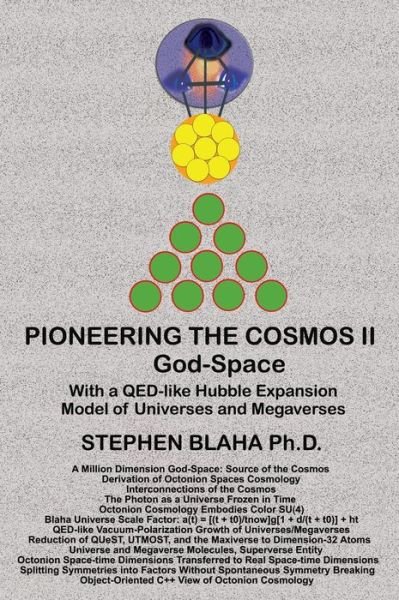
Pioneering the Octonion Cosmos II God-Space
Stephen Blaha
This volume is Part II of Pioneering the Cosmos. It extends the presentation of features of Octonion Cosmology to make it a complete theory of the Cosmos. The beginning is the million dimension God-Space, from which the other octonion spaces (forming an octet), and their instances (particles), are derived.
The spaces are shown to be atomic in the senses that they are all composed of lattices (honeycombs) of a set of symmetries that we call Dimension-32 Atoms. Each atom has a corresponding set of fermions that we call Fermion-32 Atoms. These atoms contain an SU(4) (or an SU(3)?U(1)) symmetry. Octonion Cosmology naturally contains SU(4).
The initial design of each octonion space had an octonionic space-time. In this book we transform octonionic space-times to real space-times plus a set of symmetries that interrelate the parts of fermion spectrums. We present the new connecting symmetries for a QUeST universe, an UTMOST Megaverse, and the Maxiverse. In the case of a QUeST universe these (broken) symmetries relate "Normal" and Dark fermion sectors. We embody these symmetries in an augmented Unified SuperStandard Theory (UST) that we call NEWUST. (UST was derived using Logic previously.)
We show that the conventional form of symmetry breaking via the Higgs Mechanism is not sufficient. We introduce a new form of symmetry "splitting into factors" based on two types of inheritance.
Octonion Cosmology supports hierarchies of nested space instances. We consider an example of these hierarchies. It clearly illustrates an analogy between Octonion Cosmology and an Object-Oriented C++ program. The Cosmos may be such a "program."
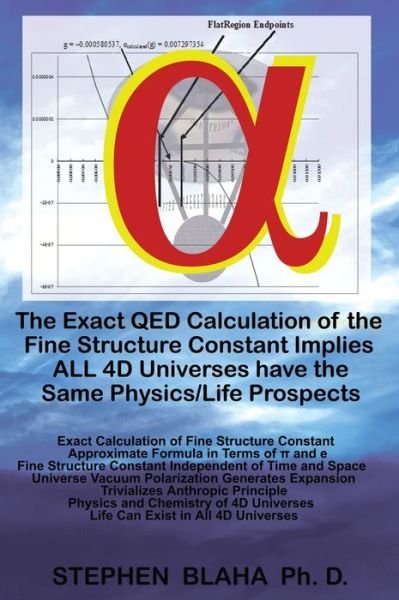
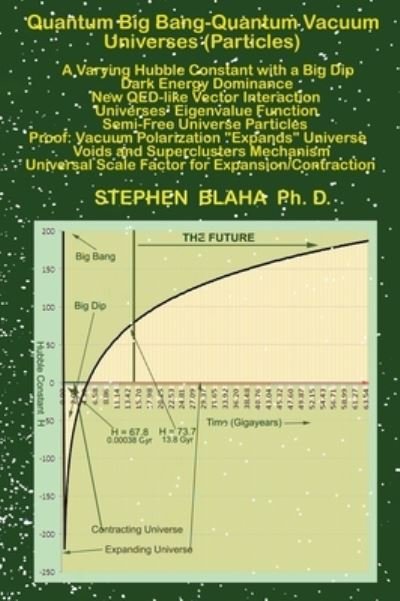
Instances of octonion spaces, such as our universe, are "particles" that expand with time. This book presents a new formula for scale factors that describes expansion from the Big Bang to the present. It is based on a QED-like vacuum polarization that has similar parameters with the author's successful calculation of the Fine Structure Constant ?.
A view of the photon is presented showing that it is analogous to a frozen universe. Part of the photon "universe" connects to the ElectroWeak interactions; part of the photon universe connects to the Strong interaction and supports a ? Vector Meson Dominance (VDM) connection.
| Media | Boeken Hardcover Book (Boek met harde rug en kaft) |
| Vrijgegeven | 15 april 2021 |
| ISBN13 | 9781735679570 |
| Uitgevers | Pingree-Hill Publishing |
| Pagina's | 112 |
| Afmetingen | 178 × 254 × 8 mm · 417 g |
| Taal en grammatica | Engels |
Meer door Stephen Blaha
Alles tonen



Bekijk alles van Stephen Blaha ( bijv. Hardcover Book , Paperback Book en Book )